
Most students are juggling chatbots, docs, notes apps, study tools, and deadline trackers, wasting time managing their workflow instead of doing the assignment. This post breaks down the best AI tools for college students in 2026.
You've got an essay due Thursday, three readings to get through, a group project nobody is managing, and an exam next week you haven't started for. You open ChatGPT. Then a separate notes app. Then Google Docs. Then you spend 20 minutes trying to remember which tab had your deadline tracker.
This is how most students use AI right now — scattered, inefficient, and burning time on logistics instead of actual work.
In 2026, the best AI tools for college students aren't necessarily the most powerful ones. They're the ones that fit how students actually work. This post breaks down what's worth your time and what you can skip.
Why Most Students Are Overcomplicating Their AI Setup
Here's a pattern that comes up constantly: a student uses ChatGPT for writing help, Notion AI for notes, Grammarly for editing, a separate flashcard app to study before exams, and a random to-do app for deadlines. That's five subscriptions, five logins, and five different places to lose track of things.
The App-Switching Problem
Every time you switch apps, you lose context — and time. Studies on task-switching consistently show it costs more focus than people expect. For students who are already stretched thin, hopping between tools is a productivity killer dressed up as productivity.
The smarter move is consolidating. You don't need the "best" individual tool for every task. You need a setup that doesn't fight you.
The Best AI Tools for College Students Right Now
Here's what's actually useful in 2026, broken down by category.
1. AI Chat: GPT-5.4, Claude Sonnet 4.6, Gemini 3, and DeepSeek v3.2
For most students, AI chat is the entry point. You ask questions, get explanations, brainstorm essay arguments, work through problem sets. In 2026 there's a real spread of capable models worth knowing.
GPT-5.4 is OpenAI's current model and handles nuance well across most subject areas — strong for writing, analysis, and general reasoning. Claude Sonnet 4.6 (from Anthropic) is particularly good at following detailed instructions and longer documents. Gemini 3 integrates well with research tasks and handles multi-modal input. DeepSeek v3.2 has carved out a niche in STEM — math, code, and step-by-step problem-solving — and it's genuinely competitive at those tasks.
The catch with any of these as standalone tools: they don't save your work, they don't know your deadlines, and switching between them means starting fresh every time.
2. AI Writing and Document Editors
A plain AI chat window is a bad place to write a 2,000-word essay. You're constantly copy-pasting, losing drafts, and reformatting. A proper AI document editor — one that autosaves and lets you work with AI inline — is a better setup.
Look for editors that:
Save automatically (losing a draft once is enough to care about this)
Let you highlight text and ask AI to revise it in context
Export cleanly to formats your professors actually accept
3. Flashcard Generators
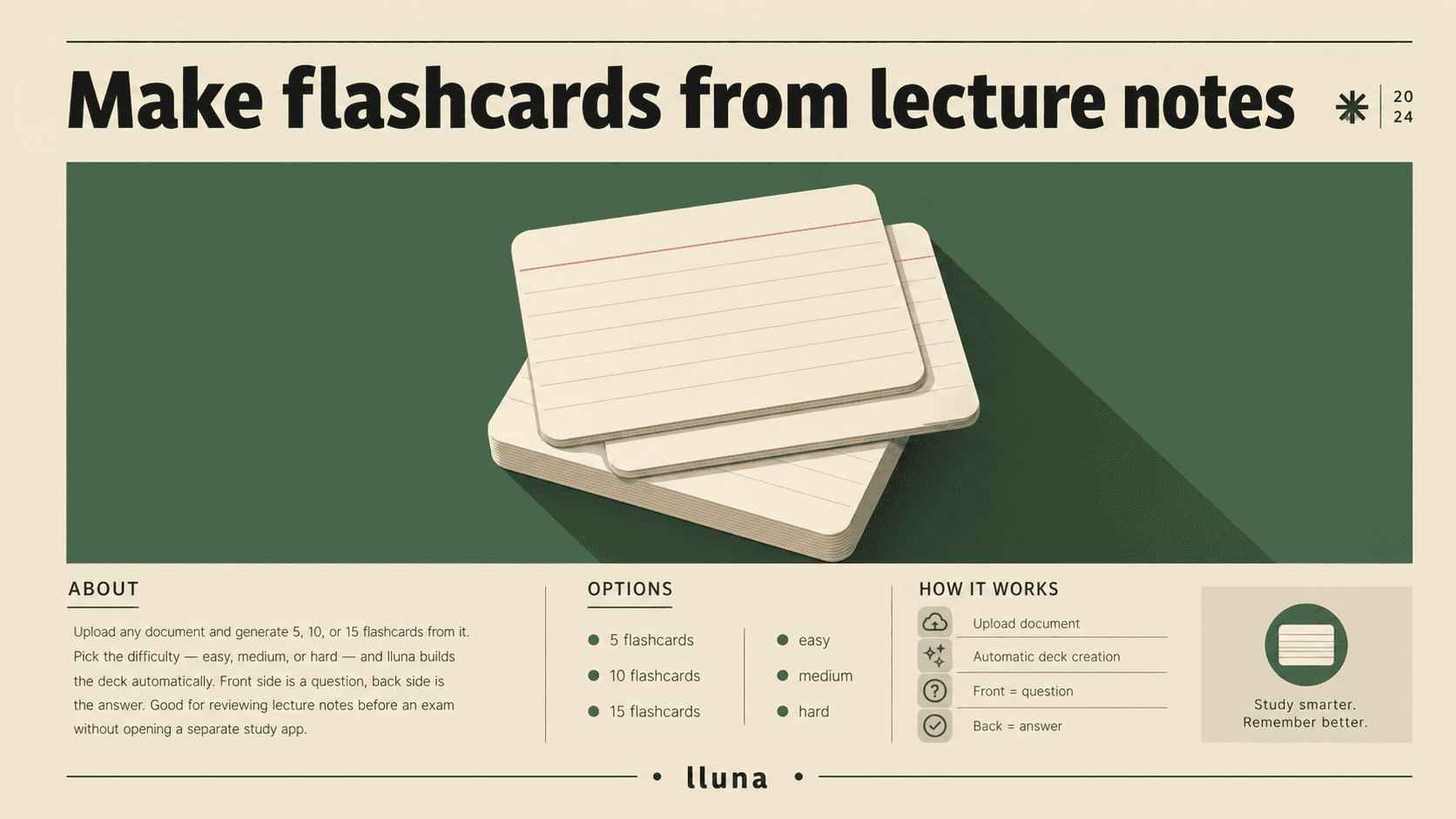
This one is genuinely useful for exam prep. Instead of manually making flashcards from your lecture notes or readings, a built-in generator can turn any document into a study deck automatically. Upload the PDF, pick how many cards you want and the difficulty level, and you have something to study from in under a minute.
The students who get the most out of this aren't using a separate app for it. They're generating cards from the same readings they already uploaded for their essay — no extra steps, no new tab.
4. Deadline and Assignment Trackers
Canvas and Blackboard exist, but most students don't actually use them as productivity tools. Keeping your assignments somewhere you look every day — ideally inside the same tool where you're doing your work — means fewer missed deadlines.
A tracker that sits alongside your writing and AI tools, instead of in a separate app, gets checked more often.
5. All-in-One AI Platforms for Students
This is where things have moved in 2026. Instead of patching together five tools, a handful of platforms now try to put everything in one place — AI chat, document editing, flashcards, and deadline tracking — built specifically for students.
The best of these is lluna (lluna.app). Here's what it actually includes.
lluna: The All-in-One AI Platform for Students
AI Chat with the Latest Models — No Switching Apps
lluna gives you access to GPT-5.4, Claude Sonnet 4.6, Gemini 3, and DeepSeek v3.2 in one chat interface. Upload your lecture notes, readings, or essays and get instant answers. Switch between models with one click and your conversation context stays intact — you're not starting over every time you want a second opinion from a different model. Summarize a PDF, brainstorm an argument, get a concept explained — it's all there without opening a new tab.
Built-In Flashcard Generator
Upload any document and turn it into a flashcard deck in seconds. Choose 5, 10, or 15 cards and set the difficulty — easy, medium, or hard — and lluna builds the deck automatically from your material. The front of each card is a question, the back is the answer. For students who are writing an essay one day and sitting an exam on the same material a week later, having the flashcard generator inside the same tool removes one more reason to open another app.
Document Analyzer
Upload your assignment document to the Analyze feature and lluna reviews it instantly — giving you complete answers, clear explanations, and structured guidance. No prompt engineering required, no extra input. You drop in the document and get results. For dense readings or complex assignments you need to get through fast, this is one of the more practical features in any AI productivity app right now.
Autosaving Document Editor
Write directly in lluna's built-in editor and everything saves as you type. Draft assignment sections, take structured notes, build a paper from outline to final version — and never lose what you wrote because you forgot to hit save. For students who have learned that lesson the hard way, the autosave alone is worth it.
Assignment and Deadline Tracker
Set a deadline for every assignment and track it with a live countdown. You can see exactly how much time remains, stay aware of what's coming up, and plan ahead without relying on memory or a separate app. It sits inside the same tool you're already working in, which means you actually look at it.
Side Panel Assistant
Keep your document open and get AI help at the same time. The mini chat panel sits beside your work with full model capabilities and conversation history intact. Ask a question, get a suggestion, refine a paragraph — without switching windows or losing your place. For writing-heavy assignments, this is the feature that makes the most difference.
The main advantage is context and efficiency. When everything lives in one place, you do not lose information between apps, you do not pay for multiple subscriptions, and your workflow stays consistent. For students managing multiple courses and deadlines, that simplicity matters.
What to Look for in an AI Productivity App
Before paying for anything, run it through these two questions.
Does It Actually Save Time?
Not in a marketing-copy sense. Does it remove steps from your actual workflow? If using the tool requires more setup than it saves, it's not for you. The best AI study tools in 2026 remove friction — they don't add new kinds of it.
Is It Built for Students?
Most AI tools are built for professionals. The use cases, the pricing, the features — they assume someone with a corporate budget and a 9-to-5 context. Student-specific tools handle things like academic deadlines, assignment types, and the fact that you're writing a lot of structured essays rather than, say, marketing copy.
If an AI for college tool makes you feel like you're using a tool meant for someone else, you probably are.
How to Actually Use AI Without Getting Penalized
This matters. Policies vary by institution, but the general direction is clear: most schools now distinguish between AI as a tool (okay in many contexts) and AI-written submissions passed off as your own work (not okay). Knowing where your school and each professor draws the line is on you.
A few practical things:
Use AI for understanding, not just output. If you ask an AI to explain a concept and then write about it yourself, that's a fundamentally different thing than pasting AI text into a document.
Generate flashcards from your readings before exams. Turning source material into active recall practice — instead of just re-reading — is one of the most effective study habits research consistently backs up.
Keep notes on how you used AI. Some professors are fine with AI-assisted work if it's disclosed. Having a clear record of how you used it (research help vs. draft generation) is useful if questions come up.
FAQ
Q: Is ChatGPT the best AI tool for college students? ChatGPT with GPT-5.4 is one of the most capable general-purpose AI tools available, and it handles a wide range of student tasks well. But as a standalone tool, it doesn't save your documents, track your deadlines, or help you study with flashcards. For students who want more than chat, an all-in-one platform like lluna covers more ground — and gives you access to GPT-5.4 alongside Claude Sonnet 4.6, Gemini 3, and DeepSeek v3.2 in one place.
Q: Are AI study tools allowed in college? It depends on your institution and your professor. Most schools have updated their academic integrity policies to address AI, and the rules vary by course. In general: using AI to understand material, brainstorm, or edit is more widely accepted than submitting AI-generated text as your own work. Always check the syllabus and ask if you're unsure.
Q: What's the difference between AI chat and an AI document editor? AI chat (like ChatGPT) is a conversation window. You ask, it answers. An AI document editor is built for writing longer documents — it autosaves, lets you work with AI in context, and produces output you can actually submit. For essays and reports, the editor experience is significantly better.
Q: Can I generate flashcards from my own lecture notes and readings? Yes. In lluna you upload any document — lecture notes, journal articles, textbook chapters — and choose how many flashcards you want (5, 10, or 15) and the difficulty level (easy, medium, or hard). lluna generates them automatically. The front of each card is a question, the back is the answer. It takes about a minute and works on anything you can upload.
Q: Do I need to pay for multiple AI tools as a student? Not if you use a platform that bundles them. A dedicated all-in-one AI platform for students like lluna gives you access to GPT-5.4, Claude Sonnet 4.6, Gemini 3, and DeepSeek v3.2 — plus an autosaving document editor, a flashcard generator, a document analyzer, and a deadline tracker — in one subscription. That's cheaper and less chaotic than paying for each tool separately.
Q: What's the best free AI tool for students? The free tiers of ChatGPT and DeepSeek cover basic chat well. For document editing and flashcard generation, free tiers tend to be limited. If you're doing serious academic work, a student-priced subscription to a platform that covers multiple tools is usually a better deal than several limited free plans.
Try lluna — Everything You Need, One Place
If you're still running a five-app setup, give lluna a try. It brings together GPT-5.4, Claude Sonnet 4.6, Gemini 3, and DeepSeek v3.2 in one AI chat, alongside an autosaving document editor, a document analyzer, a flashcard generator, and a deadline tracker — built for students, priced for students.
No more tab-switching. No more lost drafts. No more studying from the wrong material the night before an exam.