
A practical guide for college students in 2026 — covering active recall, deck size, difficulty, and the fastest workflow that actually works before an exam.
Making flashcards from a 60-page lecture PDF can take longer than reading the PDF twice. By the time you've typed out 40 cards, half your evening is gone and you still haven't tested yourself on anything. The deck becomes the homework. The studying never happens.
If you've ever sat down to "make flashcards" and then panicked at 2am realizing you spent three hours formatting cards instead of memorizing them, this guide is for you. Below: how to turn lecture notes into a usable study deck quickly, and what to do with the deck once you have it.
Why making flashcards from notes feels like a second study session
Most students underestimate how long manual flashcards take. If a card averages 90 seconds to write (read the section, write the question, write the answer, format it), 50 cards is 75 minutes. That's 75 minutes of typing. Your brain isn't being tested. It's being a copy machine.
Writing cards by hand does help a little. There is research showing the act of writing aids encoding. But the bigger cognitive lift comes from the testing itself, not the making. If you only have one evening, time spent making is time you don't get back.
There's also an honest version of this nobody likes saying out loud: deckmaking can become a way to procrastinate studying while feeling productive. You're "doing work." The cards are getting nicer. You haven't answered a single question yet.
What a good flashcard actually looks like
A useful flashcard is short, specific, and just hard enough to make you pause.
Bad: "Tell me everything about the Krebs cycle."
Better: "What molecule does pyruvate convert to before entering the Krebs cycle?"
The first one is a study guide pretending to be a flashcard. The second is a recall test. You either know the answer or you don't, and that gap tells you what to review.
The testing effect (the reason any of this works)
The reason flashcards work has a name: the testing effect. In a 2006 study by Roediger and Karpicke at Washington University, students who self-tested on material recalled around 50% more after a week than students who only reread their notes. Retrieval strengthens memory more than re-exposure does. This is why "I read it five times and still failed" is a real and frustrating phenomenon.
Why difficulty levels matter
Different difficulty does different jobs:
Easy cards (recognition prompts) are good for the first pass before class, when you just want to confirm the basics are still in your head.
Medium cards (standard recall: definitions, mechanisms, names) are the workhorse for exam prep.
Hard cards (concept-level "why does X happen?" questions) are for when you already know the material and need to defend your understanding under pressure.
If you only ever make cards at one level, you're either bored or overwhelmed. Mixing them is what makes a deck feel useful instead of punishing.
Turning 60 pages of notes into a deck in under five minutes
There are two versions of this workflow. One of them is the reason you keep losing study evenings.
The slow version
Open the PDF. Skim for important points. Highlight. Switch to a flashcard app. Type the question. Type the answer. Format both sides. Label the deck. Repeat 50 times. Somewhere in there, alt-tab to YouTube for 20 minutes. By the time the deck exists, your motivation is gone.
The faster workflow
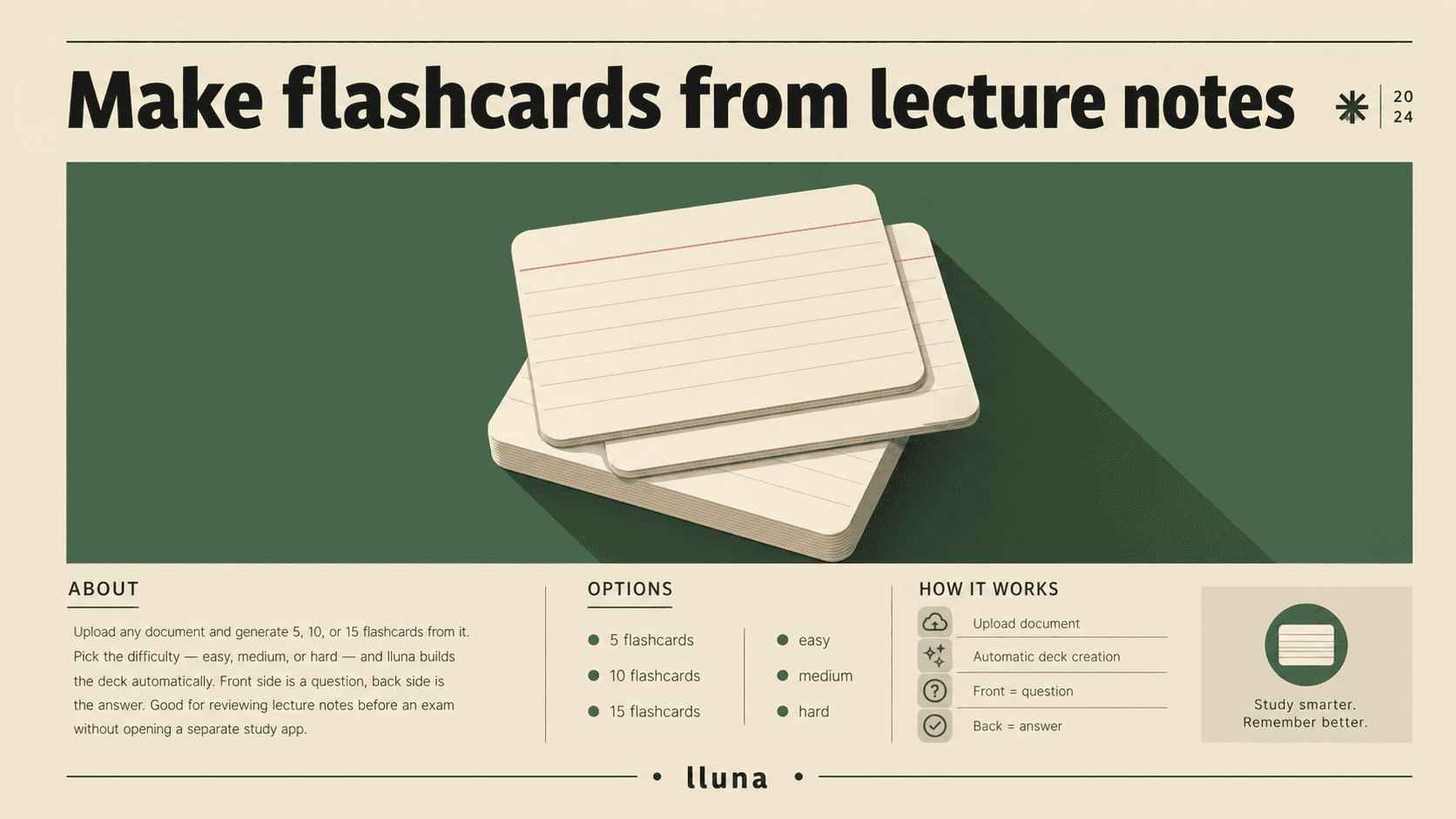
Skip the typing. Upload the document. Pick how many cards you want — 5 if it's a warm-up, 15 if you're prepping a quiz. Pick the difficulty. Get a deck.
This is what the flashcard tool inside lluna.app does. Drop in a PDF or a document of lecture notes, choose 5, 10, or 15 cards, and pick easy, medium, or hard. Front side is the question, back side is the answer. The deck is built before you'd have finished card three by hand. Because lluna is already where you take notes, write essays, and chat with AI about your readings, the document is usually one click away — you don't have to upload it again.
AI doesn't write "better" cards than you would on a perfect day. The point is that the bottleneck of building the deck disappears. You spend the next 30 minutes actually testing yourself, which is the part that moves the grade.
How to actually use a deck once you have it
A deck doesn't study itself. Three things to do:
Run through it twice fast. First pass, just see what you know. Don't dwell. Mark the ones you got wrong.
Redo the misses the same evening. Reviewing only the cards you got wrong is more efficient than starting the whole deck over.
Come back the next day. Most forgetting happens within 24 hours. A short second session the next day doubles retention with a fraction of the effort.
If you have three days before an exam: do the deck on day one, redo misses on day two, and run the whole thing once on day three. That's enough for most undergraduate material. Students who fail this approach usually try to cram everything the night before, when the second day of spacing is the part doing the heavy lifting.
When flashcards aren't the right tool
Flashcards work for definitions, formulas, vocabulary, dates, mechanisms, and any fact-shaped material. They don't work for everything.
If you're writing a literature essay, flashcards won't help you build an argument. If you're learning calculus, you need to do problems, not memorize the steps. If you're being tested on case analysis (law, business, ethics), you need to practice writing answers under time pressure.
A simple rule: if the exam question can be answered in one sentence, flashcards help. If the answer takes three paragraphs, study a different way.
FAQ
How many flashcards should I make for an exam?
For a single chapter or lecture, 10 to 15 cards is usually enough. For a full unit or exam, plan on 30 to 60. Past 80 cards, the deck becomes hard to review in one sitting, and you'll start skipping cards without realizing it.
Is it cheating to use AI to make flashcards?
No. You're not submitting the cards, you're using them to study. It's the same as having a friend quiz you, except the friend is faster. As long as the recall practice still happens on your end, the tool doesn't matter.
Is making flashcards better than rereading my notes?
Yes, by a wide margin. Rereading feels productive because the material looks familiar, but familiarity isn't the same as recall. Flashcards force retrieval, which is what builds durable memory. The 2006 Roediger and Karpicke study found self-testing produced around 50% better recall after a week compared to rereading.
Can I make flashcards from a PDF?
Yes. Upload the PDF to a tool that supports it (lluna.app does this directly), and the cards generate from the document content. Works for textbook chapters, lecture slides, and reading assignments.
Easy, medium, or hard — which difficulty should I pick?
Easy if you're cold on the material and want to confirm the basics. Medium for standard exam prep. Hard if you already feel comfortable and want to be tested at the level of "why" rather than "what." If you don't know, start with medium and adjust on the second pass.
How long before an exam should I start using flashcards?
Three days out is the sweet spot for most courses. One day is salvageable if the material is mostly definitions. For conceptual subjects (organic chemistry, advanced micro, neuro), start a week ahead so you can space the reviews properly.
CTA
If you want to skip the part where you spend three hours making the deck and go straight to studying, lluna.app's flashcard tool turns a document into a deck in under a minute. Upload your notes, pick 5, 10, or 15 cards, pick the difficulty, and start testing yourself. Free to try, no credit card.